
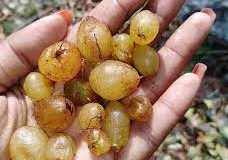
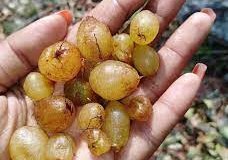
Pani amala (पानी अमला), also called bhui amala or Himalayan ground gooseberry fern, is a tuber-bearing fern traditionally consumed in parts of Nepal. The species most commonly documented under the scientific name is Nephrolepis cordifolia (L.) C. Presl., a fern that produces swollen underground tubers on slender stolons. Unlike the common Indian gooseberry, Phyllanthus emblica, pani amala is not a true berry and its plant is herb type lacking true stem. The edible portion is an underground tuber or stolon-derived structure. It is locally used as a wild food, particularly in the hills and subtropical-to-temperate regions of Nepal and it brings childhood nostalgia. It is mostly gathered from natural habitats and has long been recognized in local foraging and traditional knowledge.
Brief Description
| Feature | Information |
|---|---|
| Local name | Pani amala (पानी अमला), bhui amala, Ambeli, Pani saro |
| Common English name | Himalayan ground gooseberry; tuberous sword fern |
| Scientific name | Nephrolepis cordifolia (L.) C. Presl. |
| Plant group | Fern |
| Family | Nephrolepidaceae; classified by Kew under Polypodiaceae |
| Edible part | Underground tubers and, in some traditions, shoots |
| Growth habit | Herbaceous, tuber-producing fern |
| Nepalese altitude range | Approximately 60–2,400 m |
| Reported collection season | July–September |
| Traditional preparation | Fresh or roasted tubers |
| Important caution | Identification and food safety should be confirmed locally |
Plant Description
Pani Amala (Nephrolepis cordifolia) is a terrestrial or occasionally lithophytic fern with a short rhizome, narrow sword-like fronds and slender stolons. Some stolons develop rounded or swollen tubers below the soil surface. The rhizome is covered with scales, while the fronds are divided into numerous pinnae arranged along a central rachis. Mature fronds bear sori on the underside of the pinnae, which produce spores. The underground tubers are the feature that gives this fern its distinctive local identity as a “ground gooseberry.”. It is a perennial fern with long, divided fronds and creeping rhizomes. Its most distinctive feature is the formation of small fleshy tubers on the underground or creeping stems, which store food and help the plant survive unfavorable conditions.
Habitat
Pani Amala mostly found in tropical and subtropical regions and is common in Nepal’s moist, shaded forests, forest edges, and hill areas. It grows well in humid places with partial shade and is often seen forming patches in suitable habitats. Pani amala is associated with moist, shaded or partially shaded habitats, including forest margins, slopes, rocky locations and other sites where soil moisture is available. It is widely distributed to area 60–2,400 m above sea level. The species is also native across a broad tropical and subtropical Asian-to-Pacific range, including Nepal, India, Bhutan, Bangladesh, China and Southeast Asia. Local abundance can vary according to habitat disturbance, harvesting pressure and seasonal moisture.
Uses and importance: Is Pani Amala edible?
The tubers are the main edible part and are collected by local people as a wild food. They are valued as a seasonal forest resource, especially in rural areas, and contribute to food diversity and local ethnobotanical knowledge. Fresh and roasted tubers of pani amala have been reported as food among local communities in Nepal. A nutrient-analysis study examined moisture, dry matter, carbohydrate, starch, crude protein, fat, crude fibre, ash, calcium and phosphorus in different parts of the plant. The study reported that the tubers contained relatively high moisture, fat, carbohydrate and calcium, while protein was highest in the rhizome. These findings describe the composition of samples tested in that study; nutrient values may vary with plant part, maturity, soil, location and preparation method.
Medicinal value: The plant is sometimes mentioned in folk medicine, but its medicinal properties are not well studied scientifically. Some traditional users consider it refreshing or beneficial, but more research is needed to confirm any health effects.
Other importance: Besides food and folk use, the plant is ecologically important because it helps maintain ground cover in forest understories. It also has value for biodiversity conservation, indigenous knowledge, and possible future study as an underutilized wild edible plant.
Health disclaimer: This article documents traditional knowledge and published plant research. Pani amala should not be used as a substitute for diagnosis or treatment by a qualified health professional.
Conservation of Pani Amala
Pani amala is a wild food resource, so harvesting should be carried out carefully. Removing tubers and stolons can damage the plant and reduce its ability to persist at the collection site. Harvest only a small proportion from abundant populations, leave healthy plants undisturbed, avoid collection from protected areas without permission and never remove the entire colony. Recording the location, habitat, harvesting season and local name can help improve documentation of this under-studied food fern. Community cultivation and propagation trials may provide a more sustainable alternative to repeated collection from wild populations.
More to read: Nephrolepis cordifolia (L.) C.Presl | Plants of the World Online | Kew Science
More wild edible plants of Nepal: 24 Local wild fruits of Nepal: Identification & conservation – Think Like A Plant