
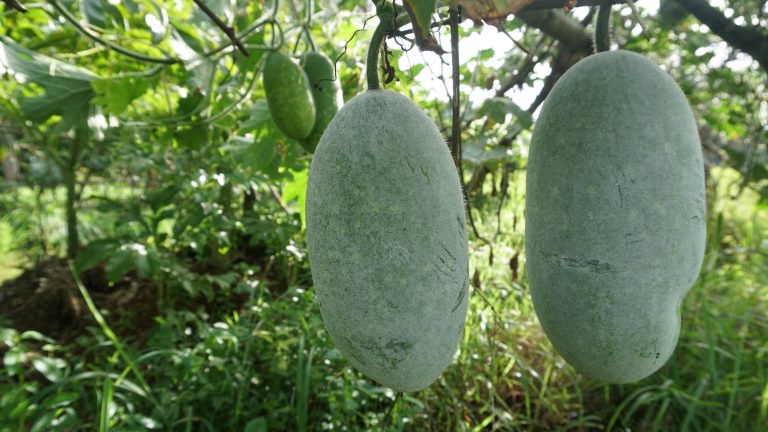
Benincasa hispida, commonly known “Ash Gourd” or “Wax Gourd” and locally known as Kubhindo (कुभिन्डो) in Nepal is a large, climbing vegetable widely grown in Nepal’s Terai and mid-hills. It is valued both as a kitchen vegetable and as a traditional remedy in Ayurveda and local folk medicine.
Kubhindo is a warm-season, monoecious (male and female flowers on the same plant) cucurbit that produces very large, cylindrical to oval fruits covered with a fine, whitish waxy coating. In Nepal, it is commonly cultivated in home gardens and small farms for its tender immature fruits, which are used in curries, pickles, Murabba (candied preserve), and soups. Beyond food, Kubhindo has long been used in Ayurveda under the name “Kushmanda,” where it is considered cooling, nourishing, and supportive for nerve and urinary health.
Kubhindo has religious value in Nepalese culture. During Dashain festival (the biggest festival of Nepal), Kubhindo is used as sacrificial item to goddess Durga. But these days, it is hard to find this fruit around.
Distribution and Adaptation
Tropical and subtropical Asia; widely cultivated from India through Southeast Asia to China and Japan. In Nepal: Grown mainly in the Terai and lower hills where summers are warm and dry enough for vigorous vine growth.
Plant Description
Annual, climbing or trailing herb with stout, angular, hairy (hispid) stems. Vines can spread several meters and need support (trellis, fence, or ground spread). A large fruit, pepo (fleshy berry), highly variable in shape: cylindrical, ovoid-oblong, or almost round.
Culinary and Other Uses
As a vegetable: Immature fruits are cooked as curry, stir-fry, or added to soups and stews. Kubhindo is often made into murabba (sweet preserve), pickles, and used in festive or medicinal preparations. Young shoots and flowers can also be eaten as greens in some regions.
Medicinal Value
In Ayurveda and related traditional systems, different parts of Kubhindo (fruit, seeds, leaves, roots, rind) are used for various health purposes. Known as “Kushmanda,” it is considered a cooling food that helps reduce excess body heat and supports conditions linked to high Pitta.
Nervous system support: Used for nerve-related disorders, epilepsy, convulsions to support memory and cognitive function.
Urinary and kidney support: Fruit rind and whole fruit are used as a diuretic to promote urine flow and help in urinary dysfunction and summer fevers.
Traditionally used in kidney-related complaints and urinary stones.
Digestive and metabolic support:
Modern studies report anti-inflammatory, antioxidant, anticancer, and cytotoxic activities from extracts of fruit, seeds, and leaves, largely attributed to triterpenes, flavonoids, sterols, and other phytochemicals.
More about kubhindo: Taste of Nepal: Kubhindo – Ash Gourd (कुभिन्डो)
More wild vegetables: Top 10 Wild/Indigenous Vegetables of Nepal with their Identification – Think Like A Plant