
Overview of Kundri
Ivy gourd, also known locally as Kundru / Kundri / Tindora / kovai / scarlet gourd is a perennial cucurbitaceous vine crop with small fruit used as raw fruit or cooked as a green vegetable. It has many medicinal and health benefits. Kundri is a low-calorie, cholesterol, and fat-free vegetable with high dietary fiber. Kundru is native to tropical Africa and the Indo‑Malayan region and now occurs widely across the world tropics and some Pacific/Caribbean islands as a cultivated and naturalized vine. It is a familiar kitchen‑garden and wild climber in the subtropical lowlands of Nepal and northern India.

Plant Morphology / Botany of Kundri
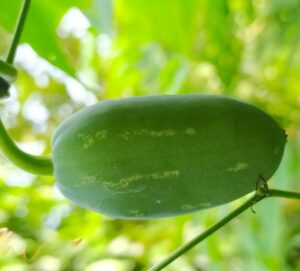
The plant is perennial, dioecious, climbing/trailing vine; tuberous roots; tendrils; leaf shape; flower type (white, star-shaped). The leaves of kundri are alternate, simple, broadly ovate to pentagonal or almost circular in outline, often shallowly 3–5‑lobed. Flowers are unisexual, axillary, usually solitary (male flowers sometimes in pairs or short racemes). The kundri fruit is small, ovoid/elliptical fruits, green with stripes when immature, turning scarlet red when ripe; size range (about 4–10 cm long).

Importance and Uses of Kundri
Food: Young green fruits are the main edible part: Cooked as curries, stir‑fries, pickles, chutneys and in mixed vegetable dishes. It is valued for mild flavor and crisp texture; widely sold in local markets in Nepal and India. Leaves and young shoots are also eaten in some regions as a leafy vegetable.
Other uses: Grown as an easy, low‑input kitchen‑garden crop on trellises, fences or as a ground cover. Used as fodder in some areas; vines and leaves are fed to livestock. In some traditional systems, leaf paste or fruit pulp is applied externally for skin eruptions, burns and insect bites.


Medicinal and Nutritional Value of Kundri
Kundri fruits are low in calories and provide dietary fiber to support gut health, Vitamins (notably vitamin C and some B‑vitamins), Minerals such as calcium, phosphorus and iron, Carotenoids and phenolic compounds with antioxidant activity. Leaves are reported to be rich in antioxidants and certain minerals, contributing to their traditional use in health‑promoting diets.
Traditional (ethnomedicinal) uses: Across South Asia and parts of Africa, different parts of Kundri (leaves, fruits, roots, stems) are used in folk medicine for diabetes and urinary disorders, Fever, bronchitis, asthma and other respiratory complaints, Jaundice, liver disorders and digestive problems (ulcers, diarrhea, stomach pain), Skin diseases, burns, wounds, insect bites and eye infections.


Note: All the photos taken by Realme X3 Superzoom phone by the author.
More to read: Top 7 Ivy gourd (Kundru) Nutrition facts and Health benefits
More wild vegetables of Nepal: Top 10 Wild/Indigenous Vegetables of Nepal with their Identification – Think Like A Plant
Healthy and nutrition kuldhy guard🤩
This looks like wild variety which has bitterness. I had one , I uprooted. The good variety plant is available in market . Again I have planted the usual one.
It is not entirely wild
Thank you for sharing this piece. Nicely worded and great clicks.
Thanks & welcome 🙂
I have not seen this type of plant. What does it taste like?
Like cucumber or other gourds…some fruits have bitter taste too
Thank you.
Amazing!!!
Well shared ! Kundru is very healthy! 👍👍
That was very interesting to see the progression of the growth cycle. I haven’t seen this plant before. How big does it grow?
Not much, the full size is just like the last photo….size is almost like kiwi fruit.
Kundru fry is very tasty and it’s very healthy also. Well shared.
Some have bitter taste
Actually what we get in market are not bitter 😜
I have a plant at home, grown naturally (not planted by me) and it has bitter taste.
O ! 🙄
Love the pictures!