
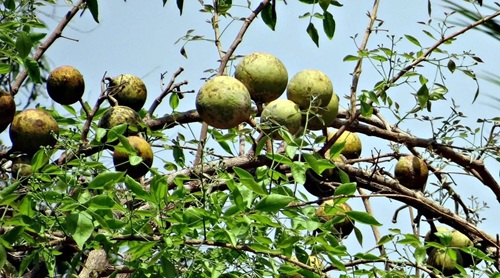
Wood Apple (Aegle marmelos), locally known as Bel, Bael (बेल) in Nepal and India, is an important indigenous fruit with high medicinal value. Bel belongs to the citrus family, Rutaceae, and is valued for its nutritious, traditional healing properties, environmental benefits and deep religious significance in Hindu culture. In Nepal, the tree is especially associated with the Terai, Siwalik, Inner-Terai and lower mid-hill regions.
Distribution of Bel
Bel natively grows across southern Nepal, from east to west. It is commonly found in the Terai, inner Terai and foothills and the Siwalik hills. The plant generally grows at elevations from about 150 to 1,220 masl, particularly along riverbanks, forest margins, village surroundings and open, sunny locations. Bel prefers warm and comparatively dry climates, well-drained loamy or sandy soil and good sunlight. It can be grown in arid regions without proper irrigation facility. Bel is also planted around homes, farms, temples and community forests.
Botanical Characteristics of Bel
Bel is a slow to moderately growing, medium-sized, thorny tree that can reach up to 15 meters in height. Its branches may bear sharp thorns, while the bark is greyish-brown and rough. The leaves are aromatic and typically trifoliate, consisting of three leaflets. Because of this three-part leaf structure, bel leaves have special importance in Hindu culture and used mostly for Lord Shiva.
The flowers of Bel are small, fragrant and greenish white. They generally appear during spring season. The fruit is round or oval, with a hard, woody shell that changes from green to yellowish when mature. Due to this hard shell, it is called wood Apple. Inside, it contains orange-yellow pulp, numerous seeds and a pleasant aromatic smell. Bel fruits mature during the warmer months and are collected in several parts of Nepal from spring to early summer.
Importance and Uses of Bel
- Bel is an underutilized but valuable fruit tree in Nepal.
- Fully ripe fruit pulp is used to prepare juice, squash, sherbet, jam, jelly, syrup and traditional beverages.
- The pulp can also be eaten fresh or dried for later use.
- Bel juice is particularly popular during hot weather because they are refreshing and culturally familiar.
- Bel tree provides fuelwood, fencing material and shade.
- Its hardy nature makes it suitable for dry areas and low-input farming systems.
Medicinal Value of Bel
- Bel has a long history in Ayurveda and Nepalese traditional medicine.
- Different parts are used for different purposes.
- Fruit, leaves, bark, roots and seeds are traditionally used for various health purposes.
- Unripe fruit is commonly regarded as astringent and is traditionally used for diarrhoea and dysentery.
- Ripe fruit is considered digestive and is used in beverages and preparations for digestive wellness.
- Bel preparations are used for stomach discomfort, constipation, respiratory complaints and general weakness.
- Excessive consumption or inappropriate use of herbal preparations may cause problems, and pregnant women, children and people taking medicines should consult a qualified health professional before medicinal use.
Religious Value of Bel in Nepal
Bel is one of the most sacred tree in Hindu culture. Its trifoliate leaves are offered to Lord Shiva, particularly during Shivaratri and other religious ceremonies. Bel trees are often planted near temples and sacred places, and devotees collect the leaves and fruits for worship. The tree also has importance in Buddhist and Newar cultural traditions.
Newar community of Nepal uses the fruit in Bel Bibaha, which is a traditional ceremony in which a girl is symbolically married to the bel fruit. This practice gives the plant exceptional cultural and social importance.
Therefore, Bel is much more than a wild fruit tree in Nepalese culture. It is a source of food, traditional medicine, rural livelihood, biodiversity and spiritual identity. Conservation and scientific cultivation of Bel can help preserve Nepal’s natural and cultural heritage.
More local fruits of Nepal: 24 Local wild fruits of Nepal: Identification & conservation – Think Like A Plant