
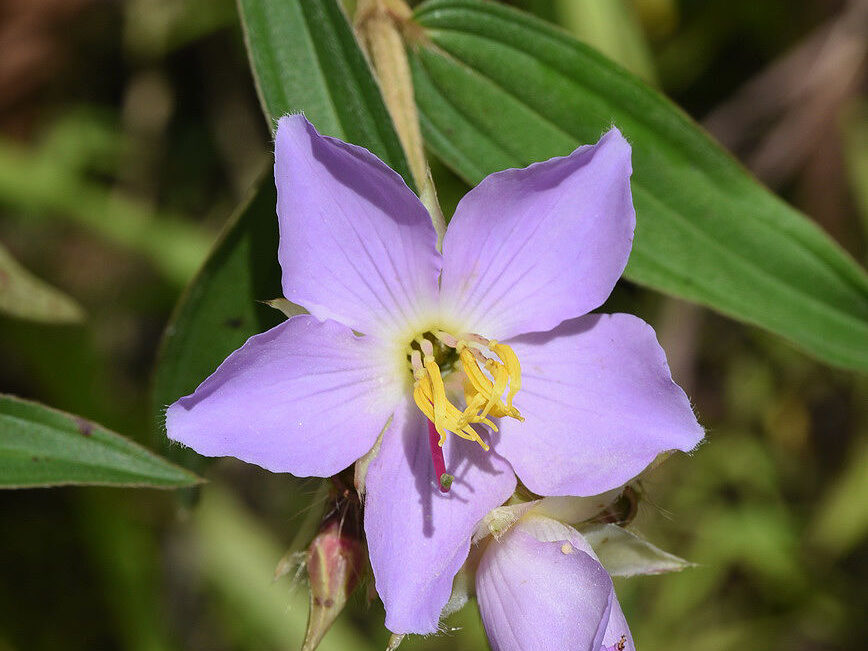
Osbeckia is a wild indigenous plant commonly found around Himalayan region countries including Nepal, China. It is common fruit in hills of Nepal, known as Angeri (अंगेरी) or Kali Angeri,Thulo chulesi, Chulesi, Seto chulesi in villages of Nepal. It is a medicinal shrub gaining scientific recognition for its traditional antidiabetic properties. It has other names across Asian continent.
India: Boga phutkola (Assamese); Yachubi (Manipuri), Phutuki (Bengali), Katalai (Tamil), Nekkare (Telugu), Senduduk (Malaysia), Harendong (Indonesia), Khlong kheleng (Thai), Bowitiya (Srilanka).
Plant Description
This erect perennial shrub grows up to 1.5 m tall with distinctive 4-sided stems covered in dense hairs. It has showy flowers appear in terminal clusters—5 pink, white, or rarely purple petals (1.5–2.5 cm) with 10 stamens. Flowering in August–October; fruits mature September–December.
Distribution
It grows well at 500–2,300 m altitude in scrub, grasslands, forest margins, and streamsides across Nepal, Bhutan, NE India, Laos, Myanmar, Thailand, Vietnam, and China (Yunnan, Guangxi, Xizang).
Uses/Importance/Facts
- Antidiabetic: traditionally used for type 2 diabetes.
- Treats dysentery, water diarrhea, cough, gastritis.
- Lowers blood glucose by inhibiting gluconeogenic enzymes.
- It is officially recognized for Medical Research for antidiabetic use in India.
- It has two varieties: albiflora (pure white petals) and nepalensis (pink-purple petals)
- It is named after Nepal due to its first discovery in Exotic Flora (1822) from Nepali specimens.
- It is used as enzyme inhibitor, reducing excessive glucose production by the liver