
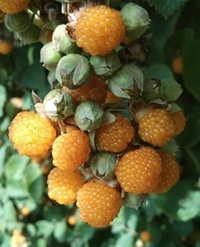
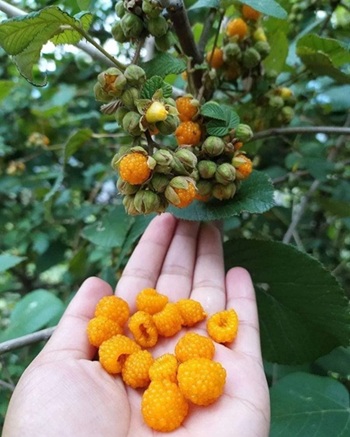
Ainselu (Rubus ellipticus) commonly called the Golden Himalayan Raspberry, is a wild fruit shrub found across the Himalayan region and other parts of South and Southeast Asia. In Nepal, it is a popular seasonal fruit from forests, hillsides, and open scrubland, where it is appreciated for both its taste and its cultural familiarity. The plant belongs to the Rosaceae family and is one of the well-known wild fruits of mountain landscapes. It is eaten fresh and is especially popular among children and people living near forested hills. (24 Local wild fruits of Nepal: Identification & conservation – Think Like A Plant)
Local names around the golbe
Nepal: Ainselu or Aiselu, ऐंसेलु
English: Golden Himalayan Raspberry, Yellow Himalayan Raspberry
India: Hisalu (Kumaon), Hisol (Garhwal) Nyinch (AP), Sohshiah (Meghalaya), Jetulipoka (Assam), Khaseemjeeo (Sikkim).
Plant description
- It is a thorny shrub with arching stems and compound leaves.
- Fruits are usually round to slightly oval, golden-yellow when ripe, and soft with a sweet-tart flavor.
- It is wild, hardy plant in open hillsides, forest margins, and shrubby areas, showing strong adaptation to mountainous environments.
Distribution
The species is native to the Himalayan region and is found in Nepal, India, Bhutan, and nearby parts of Southeast Asia where suitable hill and forest habitats exist. In Nepal, it is widely distributed in mid-hill areas and is especially visible during the fruiting season.
Importance and uses
- Eaten fresh as a seasonal wild snack.
- Used for juices, jams, and local homemade preparations.
- Important part of local biodiversity, natural wild food system and supports traditional foraging practices.
- It has social and cultural meaning in hill communities, where seasonal wild fruits are part of childhood memories and rural food habits.
- It contributes to household food diversity and reflects the close relationship between people and forest ecosystems.
- This fruit is a symbol of Nepal’s rich wild plant heritage and mountain identity.
Medicinal value
- Traditional use links with digestion and appetite support.
- Local communities have used it in folk medicine for minor health concerns.
- It has nutritional value and is being discussed for its potential health-related properties.
Lovely! I like raspberries. They grow nicely here in Scotland too.
The wild type are of wonderful taste and flavour 😍